Bokashi
What is bokashi?
Bokashi is a Japanese word meaning “fermented organic matter.” Developed in the early 1980s by Dr. Teuro Higa, a professor at the University of Ryukyus, Okinawa, Japan, the method involves layering kitchen scraps with Bokashi bran in a sealed bucket. Bokashi bran consists of either wheat germ, wheat bran, or sawdust combined with molasses and effective microorganisms (EM). These microorganisms ferment the food waste, removing pathogens and preventing bad odours.
Why bokashi?
If you’ve ever looked into composting your food waste, you will probably have seen lots of rules about what you can and can’t put in your compost bin. Rules like ‘you mustn’t compost cooked food, meat, grains, dairy…’. The result: quite a bit of our food waste still goes into the general waste bin and gets taken to landfill, or the incinerator.
The reason for these rules is that some foods smell bad when they go straight into the compost bin. They are more likely to attract rats, insects and other pests, and they can carry disease-causing bacteria. So, in a bid to prevent people being put off composting by the smells and the pests, the advice is often just to stick to fresh fruit and vegetable waste.
Bokashi is a way of treating your food waste, so that it can all be composted. If it was recently alive, you can bokashi it, then compost it. Bones, meat, fish, dairy, grains, cooked foods… all of it can go in. The only exception is liquids. If your bokashi bin gets really wet, the process doesn’t work.
So how does it work?
Bokashi fermentation transforms sweet (simple carbohydrates) into sour (acid). Take some food waste, add bokashi bran, cover it, and wait a week or two. Over that time, acid levels increase and lower the food’s pH; a lower pH also inhibits undesirable microbes that can cause unpleasant smells and spread diseases.
If you’re thinking this sounds a bit like what happens when you make pickled and fermented dishes such as kimchi, sauerkraut or kefir, you’d be right. Humans have been using fermentation for thousands of years to preserve food.
Equipment
The bucket
Sellers of bokashi paraphernalia will want to sell you a pair of bokashi buckets with a tap at the bottom, to drain off the liquid that can collect at the base of your bucket. In practice, we have found that the taps can be awkward and leaky, the buckets are expensive and there is no real need to drain off the liquid. Instead, you can buy some simple plastic buckets with a tight-fitting lid, and scrunch up some paper or cardboard in the base to absorb any liquid. It can be handy to have three or four, so that you can leave your bokashi waste to ferment for longer without running out of buckets.
The bran
Bokashi bran is wheat bran inoculated with a special formula of lactic acid bacteria, actino bacteria and yeasts called EM (Effective Microorganisms), patented by EMRO in Japan. It is possible to make your own bokashi bran, but you only need 2g of bran per litre of food waste, which works out as less than 1kg for six months for a typical family of four, so for most people it’s not worth the bother of making their own
You have now completed the first stage of the bokashi process, and you’re ready to compost your fermented food waste.
Step by step – Ferment your food waste
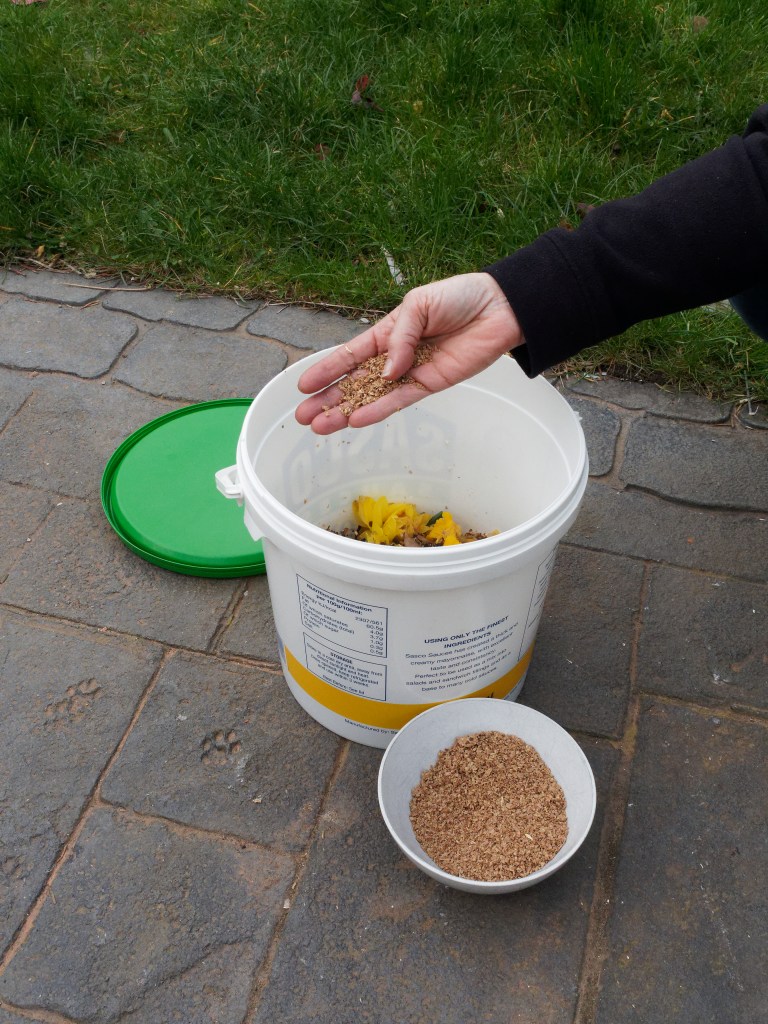
- Sprinkle some bokashi bran on the base of your empty bucket. A generous pinch should do it.
- Gather the food scraps that you want to compost. We recommend collecting them and adding them at the end of the day. That said, you can get away with opening your bucket more frequently sometimes. You can also leave food scraps for two or three days before adding them, if that is easier.
- Chop any big bits of food waste. Ideally you’re aiming for chunks no bigger than 5cm. Whole fruit or vegetables are particularly hard to compost, as their skin protects them from decomposing, so make sure to chop them up. This makes fermentation go faster, and also prevents pockets of air around the bigger pieces of food.
- Add enough food waste to form a 1 to 2 inch layer in the bucket.
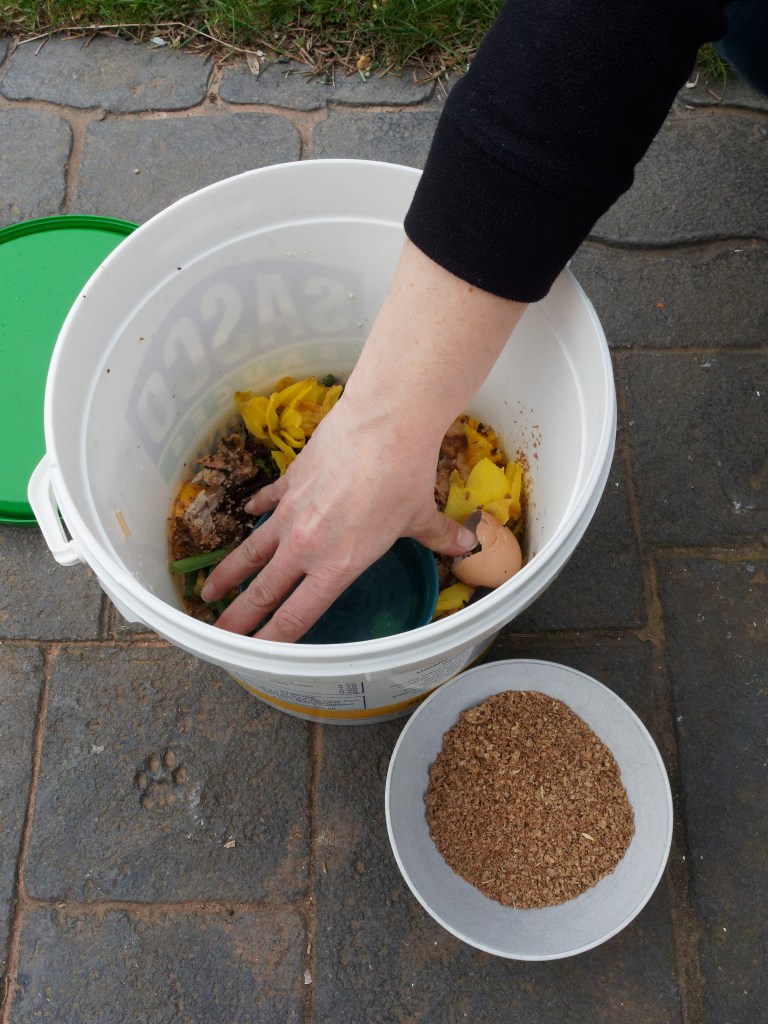
- Sprinkle on about a teaspoon, or a generous pinch of bokashi bran. You only need a little, but there’s no harm in adding too much. So while you’re new to it, be generous. As you get used to the process, experiment with adding less.
- More food to add? Pour in another 1 to 2 inch layer, and sprinkle again. Keep going till all your food waste is added. The key thing here is that you’re adding some bokashi bran for every 1-2 inch layer of food. You’re aiming for all the food to be within about an inch of a bran flake.
- Press down your food waste. This is to eliminate pockets of air, as lactic acid bacteria like an oxygen-free environment to ferment your food quickly.
- Seal the container. Again, we’re aiming to reduce the amount of oxygen present. Sure, each time you open the bucket, you introduce more oxygen, but lactic acid bacteria are able to tolerate oxygen, and as they get fermenting, they will quickly replace the oxygen in the bucket with the gases they produce during fermentation.
- Keep filling the bucket until it is full. Try to fill it right to the top, so that the lid is pressing down on the food waste. Again, this is to keep out oxygen as much as possible.
- Leave your bucket for a minimum of two weeks. But you can leave it for months if you want. The process will work faster if you keep the bucket inside, at room temperature. But if you need to leave it outside, just give it longer to ferment during the winter. This is why it can be handy to have some extra buckets. In Summer, keep it out of direct sunlight.



Composting your fermented food waste
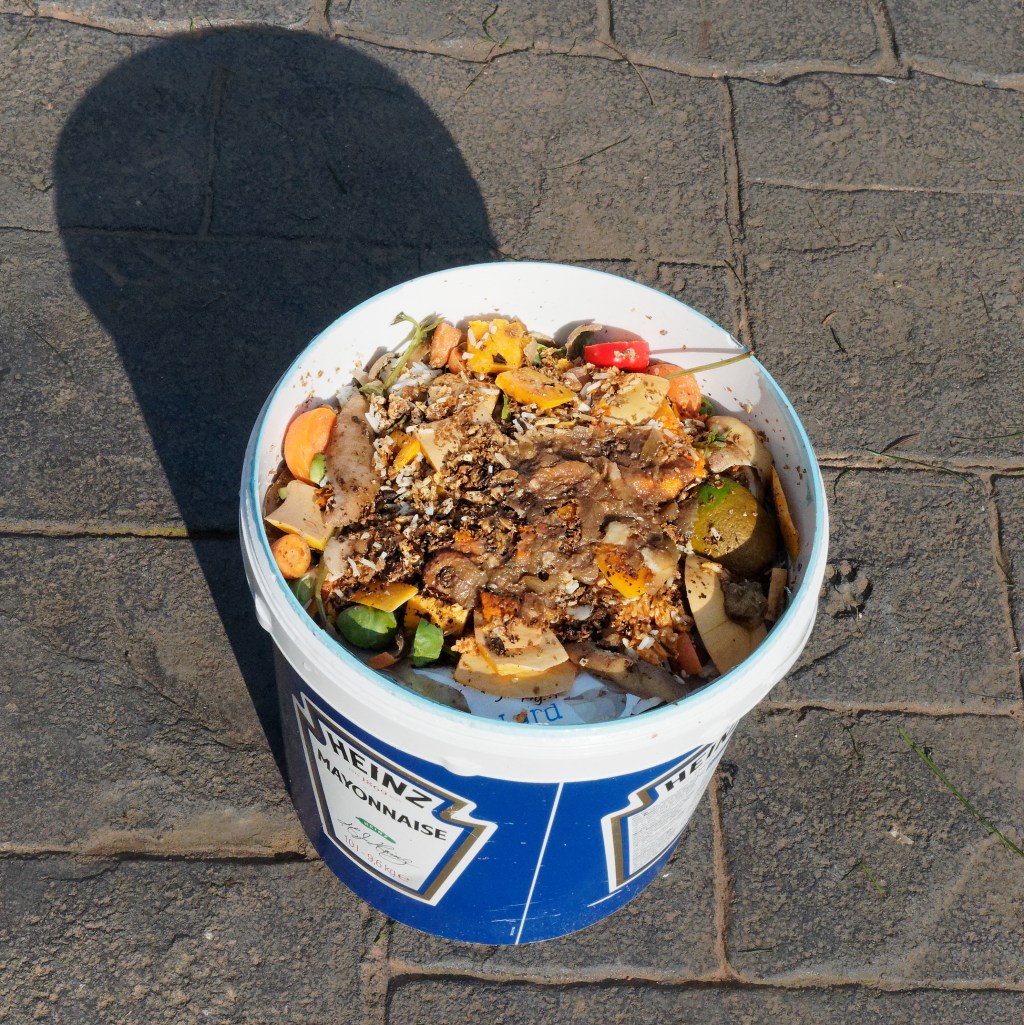
At this stage, your bokashi will not look like compost. The food waste still looks like fresh food, and it should have a mild, acid smell like a pickle. You may see some fuzzy white mould on top, which is fine. If you see green, black or orange mould, it’s gone wrong. You can still compost it, but it may be a little ‘icky’!
You have several options now to compost your bokashi:
Compost it
You can just add it to your regular compost bin. Mix it thoroughly with an equal amount of soil or compost – you need the soil microbes to move in and digest the bokashi. They will do this in 4 to 6 weeks. It takes longer in cold weather, and goes faster when it’s warm in summer.
Make a soil factory
This option is like burying it, but it leaves you with a supply of soil that you can use when and where you want. It saves you digging up your beds, and you can contain it so that pests don’t try to eat it.
Indoors:
- Find a plastic tub with or without a lid and put it somewhere warm.
- Cover the base of the tub with 5-10cm of soil.
- Add 50:50 soil and bokashi and mix well so most of the food scraps have soil contact. This is a good chance to reuse the soil from old pot plants.
- Cover the mix with 10 cm of soil. You will now have a sort of “soil sandwich”. The soil factory needs to breathe, so no lid is needed.
- Fix insect mesh or tight-weave fabric over the top, so that insects can’t get in. We tie it on with string or elastic.
- The mixture should be not too wet and not too dry, about the same moisture content as good soil (if your soil factory smells it’s most likely too wet).
- Mix it now and then if you want the process to go faster, but it is better to leave it. Mixing introduces oxygen and starts an oxidation process that creates heat. Heat is an energy loss and it’s better if the energy can be retained in the soil for the benefit of future plants.
- The process will take from 4 to 8 weeks depending on the temperature and how small your food scraps are.
Outdoors
Essentially the same as above but outside. You can punch holes in the bottom of your container, or use a classic ‘dalek’ compost bin rather than a tub, to let the worms in. Protect from rain with a loose-fitting lid. Outside, the process may take longer in winter because the weather is colder. Soil microbes are not very active in temperatures below 10C.
For both inside and outside, once you’ve made one lot of soil, you can re-use some of it in your next soil factory, rather than finding soil from the garden every time.
DON’T Bury it
Lots of people recommend burying your bokashi food scraps, but we have found that foxes, rats and other pests will dig it up, so it’s a ‘no’ from us.
Troubleshooting
How do you know if your bokashi is going well? These are the things to look out for:
The Good
Smell – a slightly acid, vinegary smell means that fermentation is taking place.
White mould – a furry white mould on your bokashi is a good sign. It’s some of the yeast from the bokashi blooming on your food waste.
Fresh looking – the food will look pretty much the same as when you added the bran. It has been fermented, but not yet composted.
The Bad
Smell – a strong smell of rotten eggs, or worse, means the food is putrefying not fermenting – things have gone wrong.
Green or black mould – this is an unwanted mould, which the fermentation process should have killed off. If you see this, fermentation failed.
Brown and slimy food – it has putrefied, not fermented.
How to care for your Lactic Acid Bacteria (LAB)
Bokashi full of green or black mould? Or does it smell like death? Don’t give up if at first it doesn’t succeed. Now you know what your LAB need to ferment well, you can figure out where it went wrong, and what to do. Here are six key factors that you may need to adjust:-
Moisture
With bokashi, your friend the lactobacillus is looking for a moisture level that is ‘just right’. Damp, but not dripping wet. Normally, your food waste will be about right for moisture.
However, if you add a large amount of dry stuff such as bread, dry cereal, dry rice etc, your bokashi may dry out and fermentation will stop. Lactobacillus need to swim about on a thin film of moisture, and they will go dormant if their environment is too dry. So consider dampening the mix with water or more ‘wet’ food waste if it is really dry.
If, on the other hand, your mix is too wet, this can cause an unpleasant smell. Fix it by adding some drier stuff to the mix, such as shredded paper, cardboard or dry bread. (Don’t forget to break up the bread.)
Air
If your food waste contains lots of pockets of air, the environment is too oxygenated for fermentation to happen. Lactobacillus can tolerate oxygen, but other aerobic microorganisms may come to dominate the mix and prevent fermentation.
This is why you need to press down your food waste, and it’s one reason to chop up larger items – pockets of air are harder to press out if there are some bigger chunks of food.
You also may not have kept the bucket well sealed. Check the lid is tight, and make sure it is always closed after adding food.
Quantity of bran
If you added too little bran, or didn’t sprinkle it evenly through your food mix, pockets may develop where putrefaction takes over from fermentation. The result: a smelly, mouldy bucket. You don’t need much bran: think a heaped teaspoon per litre of food waste, or a generous pinch for each 1 inch layer. However, there is no problem with adding too much bran, so if in doubt, be generous with your bokashi bran. Perhaps start with double the bran and gradually reduce as you get to know the process.
Timing
If your food was already beginning to go off when you added it to your bokashi bucket, it may be too late for your lactic acid bacteria to move in and start fermenting. Bad bacteria will already be digesting your food via the smelly process of putrefaction. This is why we recommend adding your food waste once a day. This way, it hasn’t sat around too long attracting bad bacteria.
Temperature
Your lactic acid bacteria like temperatures between 10C and 30C. Most UK homes are between 18C and 25C, so this is the ideal temperature for bokashi. If you keep it outside in winter, however, fermentation will slow down, or may even stop completely. If you’re prepared to wait, then just keep your bokashi for a few extra weeks before trying to compost it. It will ferment eventually. If you need to turn your bokashi around faster, keep it somewhere warm indoors, so that it ferments more quickly.
Food Scrap Size
Is your bokashi full of whole butternut squash, potatoes, onions or suchlike? That may be why it’s not fermenting. Ideally chunks should be no bigger than 5cm or 2inches. This enables the lactic acid bacteria to penetrate your food quickly and ferment it. If you’re prepared to wait longer, a few larger items in your bokashi bucket, well pressed down, may not be a disaster. Give the bucket an extra week or two when full, before composting it.
Bokashi FAQs
What is bokashi?
‘Bokashi’ is Japanese for ‘fermented organic matter’ and it means the process of making food waste decompose through fermentation.
Bokashi bran is full of friendly bacteria called lactobacillus. When you add bokashi bran to your food scraps, the bacteria on the bran ferment your food, a bit like sauerkraut or kimchi. This takes out all the ‘bad’ bacteria and keeps it smelling good (it may smell a little sour, like pickle, but if it smells of death, something has gone wrong).
How much bokashi bran do I need to add to my food waste?
As a guide, aim for a sprinkling of bokashi bran for every one to two inch layer of food that you add to your bokashi bin. Take a heaped teaspoon, or a big pinch, and sprinkle it on after you have added your food waste to the bokashi bin. For meat or fish, add a bit extra.
Do I have to buy one of these expensive bokashi bins with a tap?
No. All you need is two buckets the same shape and size, with a sealed lid. Drill holes in one bucket, pop it inside the other and you’re ready to go.
You can even use just one sealed bucket. If you do this, you can add some absorbent material to line the bottom of your bin, like cardboard, newspaper, shredded paper or dead leaves, to absorb the liquid that may collect at the bottom.
How often should I add food waste to my bokashi bin?
Lactobacillus, the ‘friendly’ bacteria in your bokashi bran, work best with less oxygen. So if you open your bin often, the fermentation may not work as well. It’s best to add your food scraps once a day, but opening it more than this won’t be a disaster. At home, we have a small caddy that we fill up with food scraps on our kitchen counter, then we add it to our bokashi bin when it’s full.
Why do I have to press down my bokashi waste?
This is to remove pockets of oxygen from your food scraps, so that the lactobacillus in the bokashi can get to work more quickly. You don’t have to do it every time you add your food scraps, but make sure you do it 2 or 3 times a week, and once again when it’s full.
How long do I need to leave my bokashi bucket once it’s full?
Leave your full bucket for at least two weeks. Ideally, it should stay in a warm place, but if you don’t have space indoors you can leave it outside even in winter – it will just need longer before it’s ready. You can leave it for much longer than that if you’re not ready to compost it yet. We’ve left it for a couple of months without a problem.
What is this liquid at the bottom of my bokashi bin?
Sometimes, if your food waste has a high water content, you will find that there is a slightly smelly liquid at the bottom of your bin. This is called leachate, and it can make your bokashi bin start to smell.
If your bin has a tap at the bottom, you can use this to drain it off. It’s safe to pour down the drain. Or as it is full of beneficial microorganisms, some people like to dilute it 1:1000 and use it as a soil drench or foliar spray in the garden. Opinions are divided about this, and the research isn’t conclusive as to whether it will benefit your plants.
If you have stacked one bucket inside another, with holes in the top bucket, you can separate the buckets and rinse out the bottom bucket.
If you are just using a simple sealed bucket, line the bottom of the bucket with cardboard, paper, straw, woodchip or any other absorbent material, to soak up the bokashi liquid. You don’t have to do this, but it’s a way of dealing with the leachate if it’s bothering you.
Will my bokashi turn to soil in my bucket?
No. Your bokashi will still look like it did when you put it in, but now it has been fermented, it should smell slightly like vinegar. It will break down and transform into soil much faster than raw food scraps once you add it to your compost pile.
What is this white fluffy mould in my bucket?
This is the yeast in your bokashi blooming. It’s a sign that the bokashi process is working well, and your food is ready to compost. It’s not dangerous at all. If you see green or black mould, however, the process didn’t work as it should. If there’s only a little green/black mould, scrape it off and carry on. If it is all covered with green or black mould, throw out the contents, clean the bucket and start again.
Why has my bokashi bucket gone smelly or mouldy?
There can be a few reasons for this. The main reason is usually that the lid has been left open. On some buckets, they can pop off if there’s a build-up of gas inside the bucket. Do check on the lid regularly. Another reason may be not enough bran. Try adding a little bit more to your next batch, and see if this fixes the problem. Finally, if you put some food in that was already going bad, especially meat, the lactic acid bacteria may not succeed in overwhelming the ‘bad’ bacteria in the food. If adding a lot of meat to your bucket, make sure it’s got a good sprinkling of bran, and that the lid stays shut.
What is the right temperature for a bokashi bucket?
The bokashi process works best at room temperature – about 18 to 25C. So it’s recommended to keep your bokashi bin inside during the winter so that it can ferment. We have found that if there’s no space indoors, it’s fine to leave it outside once full: it will just take longer to ferment, and you might need extra buckets (this applies in the UK, where winters are moderately cold).
What can I put in my bokashi bucket?
You can put anything that has recently been alive: fruit, vegetables, raw meat, cooked meat, bones, bread, rice, raw food, cooked food of any kind… just make sure that you add an extra sprinkling of bokashi to any meat you add.
So can I add liquids to my bokashi bucket?
No! Lactic Acid Bacteria can’t ferment liquids, so these may make your bucket go pretty icky. If it’s not that much liquid, you could pour it onto something absorbent, like bread, and then put it in. But you could also just pour it straight onto your compost pile, if you have one. Mix it in well.
Do I have to chop up my food scraps before adding them to my bokashi bin?
This is a good idea, as the bokashi process will work better on smaller food scraps, and it is easier to remove pockets of oxygen from the bin.
Will my compost become acidic if I add bokashi?
The bokashi pre-compost is acidic when you first add it to your compost, but after two weeks it will have broken down and returned to neutral ph.
How much bran should I use?
About a heaped teaspoon (a big pinch) per litre of food waste. Use a bit more on meat and fish. It doesn’t hurt to use too much, so if you’re not sure, be generous with your bran and gradually reduce the amount as you get the hang of it.
What about rats and mice?
Rats and mice are put off bokashi by the sour smell of fermentation, but if they are really hungry they will still eat it. Rat proof mesh on the bottom of your compost bin will keep them out, or place your bin on stone slabs. See our troubleshooting guide for more information on dealing with pests.
Do worms like bokashi?
Yes they love it. They will find it too acidic at first, but after two weeks in your compost pile, they will make their way in. If you want to add it to a wormery, add it gradually at first, with an equal amount of ‘browns’ such as paper, cardboard, dried leaves and stems or woodchip.
 The Compost Connection